MarTech And The Local Business
As a business owner, it’s important to stay up-to-date on the latest marketing technology (MarTech) and how it can benefit your business. In this post, I want to talk about the benefits of improving your MarTech stack, specifically for local businesses.
First, let’s define MarTech. Simply put, it refers to the various tools and software that businesses use to improve their marketing efforts. This can include everything from email marketing platforms and social media management tools to analytics software and CRM systems.
So, what are the benefits of improving your MarTech stack as a local business? One of the biggest benefits is the ability to better target and personalize your marketing efforts. With the right MarTech tools, you can segment your audience and tailor your messaging and marketing campaigns to specific segments. This can lead to higher conversion rates and more customer loyalty.
Another benefit of improving your MarTech stack is the ability to better track and measure the effectiveness of your marketing efforts. With the right analytics tools, you can get a better understanding of what’s working and what’s not, and adjust your strategy accordingly. This can help you save time and money by focusing on the marketing channels and tactics that are delivering the best results.
Another benefit of MarTech is the ability to automate certain marketing tasks, freeing up time and resources for more high-level strategy and creative work. This can be especially beneficial for small businesses that may not have the same resources as larger companies.
In addition, MarTech can help local businesses better connect with and engage with their customers. With tools like social media management and review management, you can more easily respond to customer inquiries and feedback, which can lead to improved customer satisfaction and loyalty.
So, how can you start improving your MarTech stack as a local business? The first step is to assess your current marketing technology and see what’s working and what’s not. This can help you identify any gaps in your stack and areas where you can improve.
Next, do your research and consider the various MarTech options that are available. There are many tools and platforms out there, so it’s important to choose the ones that are the best fit for your business and your marketing goals.
Finally, don’t be afraid to test out new MarTech tools and see how they work for your business. The beauty of MarTech is that it’s constantly evolving, so there are always new tools and platforms to try out. Just make sure to track your results and see what’s working and what’s not. We offer Marketing Technology consulting and implementation for local brands here at Rainmaker Reputation AI CRM.
The benefits of call tracking inbound calls and how it can benefit your business.
First, let’s define call tracking. Simply put, it’s the process of using a unique phone number or tracking code to identify the source of inbound calls to your business. This can include calls from your website, calls from online directories or listings, and calls from ads or other marketing efforts.
So, what are the benefits of call tracking inbound calls for a local business? One of the biggest benefits is the ability to track the ROI of your marketing efforts. With call tracking, you can see which marketing channels and tactics are driving the most calls and revenue for your business. This can help you understand what’s working and what’s not, and adjust your strategy accordingly.
Another benefit of call tracking is the ability to better understand your customers and their needs. By tracking the calls that come in to your business, you can get a better understanding of what your customers are looking for and how they found your business. This can help you tailor your marketing efforts and better meet the needs of your customers.
In addition, call tracking can help you identify opportunities for improvement in your customer service. By tracking calls and analyzing the call data, you can identify patterns and trends that may indicate areas for improvement in your customer service. This can help you better serve your customers and build their loyalty to your business.
So, how can you start using call tracking for your local business? The first step is to choose a call tracking platform that meets the needs of your business. There are many options available, so it’s important to do your research and choose a platform that fits your budget and provides the features you need. We offer a platform that can handle all your call tracking and call attribution needs. It’s just one of the many benefits offered in the entire suite.
By the way… did you know Google Business Profiles, offered by Google, now allow for Call Tracking from any local business’s Google Business Profile. It’s THAT important. We can help you with this important new feature if you have not enabled it yet. Reach out to us via our Webchat.
Next, set up your call tracking system and start tracking your calls. This will typically involve creating unique phone numbers or tracking codes for different marketing channels or campaigns. Make sure to track as much data as possible, including the source of the call, the duration of the call, and any notes about the call.
Finally, analyze the data you collect and use it to inform your marketing strategy. Look for patterns and trends that can help you better understand your customers and optimize your marketing efforts.
In conclusion, call tracking inbound calls can be a valuable tool for local businesses looking to track the effectiveness of their marketing efforts and better understand their customers. By choosing the right call tracking platform, setting up your system, and analyzing the data you collect, you can drive better results for your business and build customer loyalty. So, it is a great tool to have in your marketing stack.
In conclusion,
improving your MarTech stack as a local business can have a number of benefits, including better targeting and personalization, improved tracking and measurement, automation of certain marketing tasks, and better engagement with customers. By assessing your current stack, doing your research, and being willing to test out new tools, you can take your marketing efforts to the next level and drive better results for your business.
Helping you win the game at getting the Google 7 - 11 - 4 visibility advantage
There was a time when selling was taught like it happened in a vacuum. The great copywriters and sales trainers built their craft around the moment of persuasion: the pitch, the letter, the close. Say the right words in the right order, in the room, and the sale was yours to win or lose.
That world is gone. Google's 7-11-4 research put numbers on the world that replaced it.
The modern consumer in the US does their shopping before they ever speak to you. They do their research, and now, more than ever, that research is digital. Google studied the behavior and the marketing world boiled it down to a rule worth memorizing: 7-11-4. Seven hours. Eleven touchpoints. Four locations. That is what it typically takes before a prospect trusts a business enough to buy from it.
Which means the sale is mostly decided before your sales conversation starts. This article is about winning the game that happens first.
What is Google's 7-11-4 rule?
Google's 7-11-4 rule says a prospect typically needs 7 hours of engagement with your content, 11 separate touchpoints with your brand, across 4 different locations or channels, before they trust you enough to buy.
The roots are Google's 2011 Zero Moment of Truth research, which studied how shoppers research products and services online before taking action. Honesty matters here, so let me be precise: the exact 7-11-4 figures were popularized by marketers building on Google's findings rather than printed verbatim in the original study. The behavior underneath them is pure Google, though. Their research found that shoppers consulted 10.4 sources of information before deciding, nearly double the year before, and that 88% of US customers research online before actually buying.
The direction has only steepened since. Your prospect is not waiting to be persuaded. They are out gathering the persuasion themselves.
Why doesn't a great sales pitch close like it used to?
Because the pitch is now the last touchpoint instead of the first. By the time a prospect is talking to you, they have usually read your reviews, compared you against two competitors, looked at your photos, and formed an opinion they will politely never mention.
Selling in a vacuum assumed the seller controlled the information. The consumer owns the information phase now. If your 11 touchpoints are thin (an outdated profile, three stale reviews, a website from 2016), you are asking one phone call to do the work of 7 missing hours. Even a brilliant closer loses that fight most days.
We broke down the research itself in our earlier piece on content marketing and the 7-11-4 rule. This article is about what I did with the discovery, and what we built because of it.
What did I learn about 7-11-4 as an SEO consultant?
Before Rainmaker Reputation, I made my living as an SEO consultant, ranking local companies in big, expensive markets. I learned early that ranking was only half the job. The content sitting at the top of Google speaks for your business at 2 a.m., to a stranger, with nobody there to explain it. It had better speak well.
"It's a big reason we chose our brand name. I applied a very careful standard where the content I created as an SEO consultant would not only rank, but be good brand ambassadors, play a consumer advocacy role on behalf of our clients. It ranked and was very visible after all. The better we did there, the better conversations for our clients with prospects."
Read that last line again, because it is the whole discovery in one sentence. When the visible content did its job, prospects arrived pre-sold. The calls got shorter. The trust was already there. The salesperson was confirming a decision the research had already made.
I had also heard Dan Kennedy teach "always be positioning" and "being everywhere" years before Google published numbers on it. When the 7-11-4 research landed, it read like a validation of his hunch: be present, be consistent, be found in more than one place, and let repetition build the trust no single pitch can.
Where do the 7 hours, 11 touchpoints, and 4 locations come from?
From the places your prospect already checks, whether you manage them or not:
- Your Google Business Profile and its reviews. This is the heavyweight location. Reviews are touchpoints that never sleep, written by your happiest customers in their own words. A steady review management habit turns every finished job into future persuasion.
- Your website and content. This is where the 7 hours accumulate: articles, videos, FAQs, and service pages that answer questions the way a good advocate would.
- Your social profiles. A third location, and proof you are a living business rather than a listing.
- Your follow-up. Email and text messages are touchpoints too, and the ones most businesses never send. Strong local SEO gets you found; follow-up keeps the conversation going after the first look.
Notice what is missing from that list: your sales pitch. It comes after all four locations have already voted.
How do you win the 7-11-4 game without hiring a content department?
Here is the epiphany that built this company. The standard I applied by hand as a consultant (visible content that ranks, advocates, and pre-sells) can now be delivered by systems. We have moved on to delivering marketing technology for local businesses designed to get similar results, with the same emphasis.
In practice, that means the touchpoints accumulate on their own:
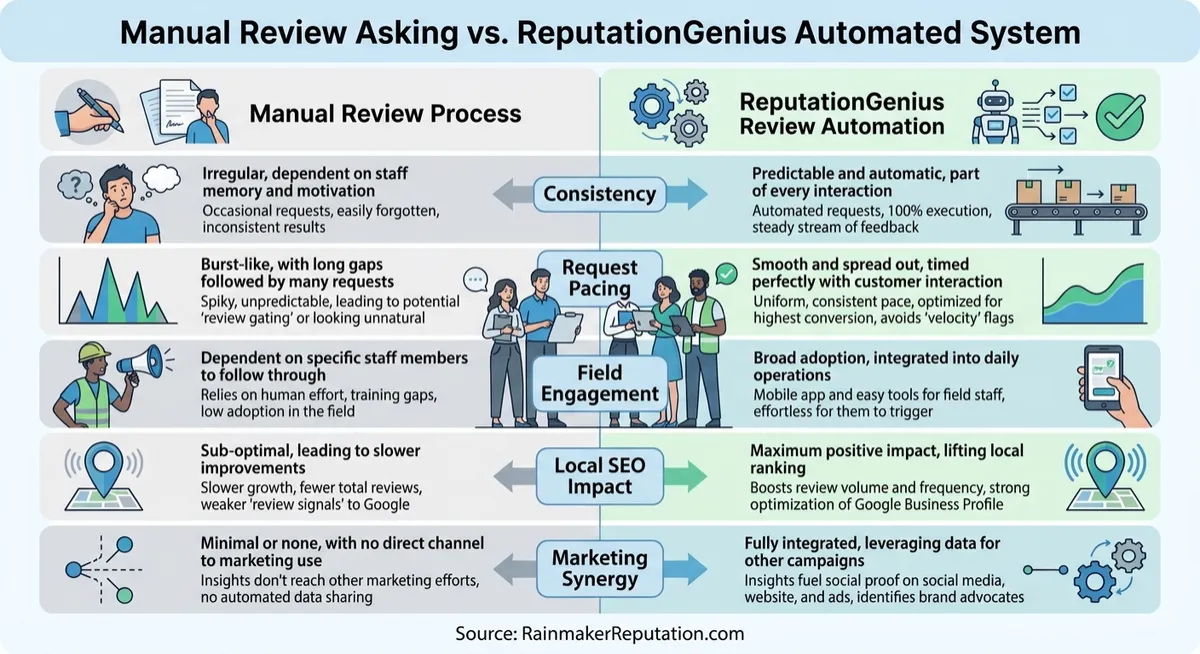
- Automated review requests after every job, so real reviews from real customers keep appearing where prospects look first. That is ReputationGenius, the review engine inside our system.
- Automated follow-up by text and email, so no prospect who found you drifts off untouched. Eleven touchpoints is a lot to remember manually. It is nothing to a workflow.
- Your content and social, planned in one place, so the hours of engagement keep stacking across all four locations instead of depending on your spare time.
None of this replaces doing great work. It makes sure the market actually sees the great work, in the places and doses the research says it takes.
Who is the 7-11-4 advantage NOT for?
It is not for businesses whose customers buy purely on impulse with zero comparison, and it is not for owners unwilling to keep a profile current or ask a happy customer for a review. Technology amplifies what is true about your business. It cannot invent it.
The trade-off is honest, too: this compounds. The businesses that win the 7-11-4 game build an asset that gets stronger every month, but it builds over weeks and months, not over a weekend. The alternative, renting attention with ads that point at a thin presence, stops producing the day the spending stops. One approach banks trust. The other rents glances.
This is built for local service businesses whose customers compare two or three providers before calling: exactly the buying behavior Google measured.
Your prospect has already had the sales conversation: with your reviews, your content, and your competitor's. The only question left is whether you were in the room.
If you want the 7 hours, 11 touchpoints, and 4 locations working for you instead of against you, start with the system that was named for exactly that job. See how our marketing technology is put together, and let's talk about what it would look like running your visibility while you run your business.

FEATURES
Social Media Management
AI Agents
Search Optimization A.I. Agent
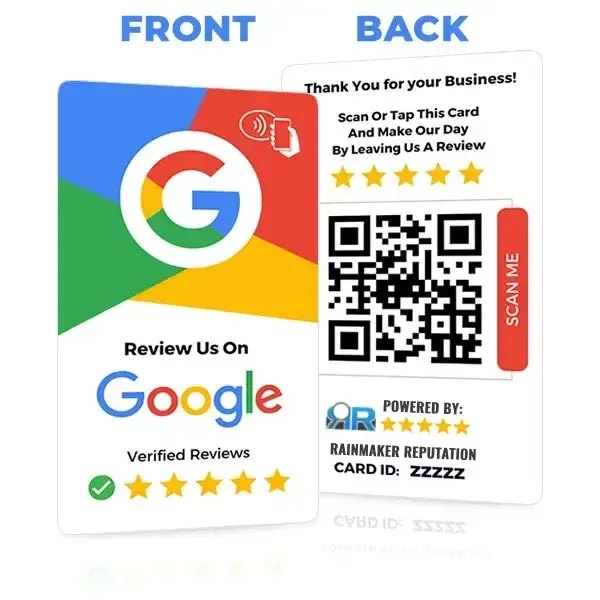
Review Collecting Systems
Forms & Surveys
Online Appointment Booking
Membership & Course Builder
Automated Nurture Sequence
Email & SMS
Phone System & Autodialer
Learn More



Rainmaker Reputation AI CRM is a CRM & AI Automation suite that helps Local Brands, Business Coaches & Content Creators solve the problem of how to properly connect with prospects & customers in order to build profitable momentum & growth through getting their businesses more reviews, better reputations in their markets, & automated simplified CRM processes.